

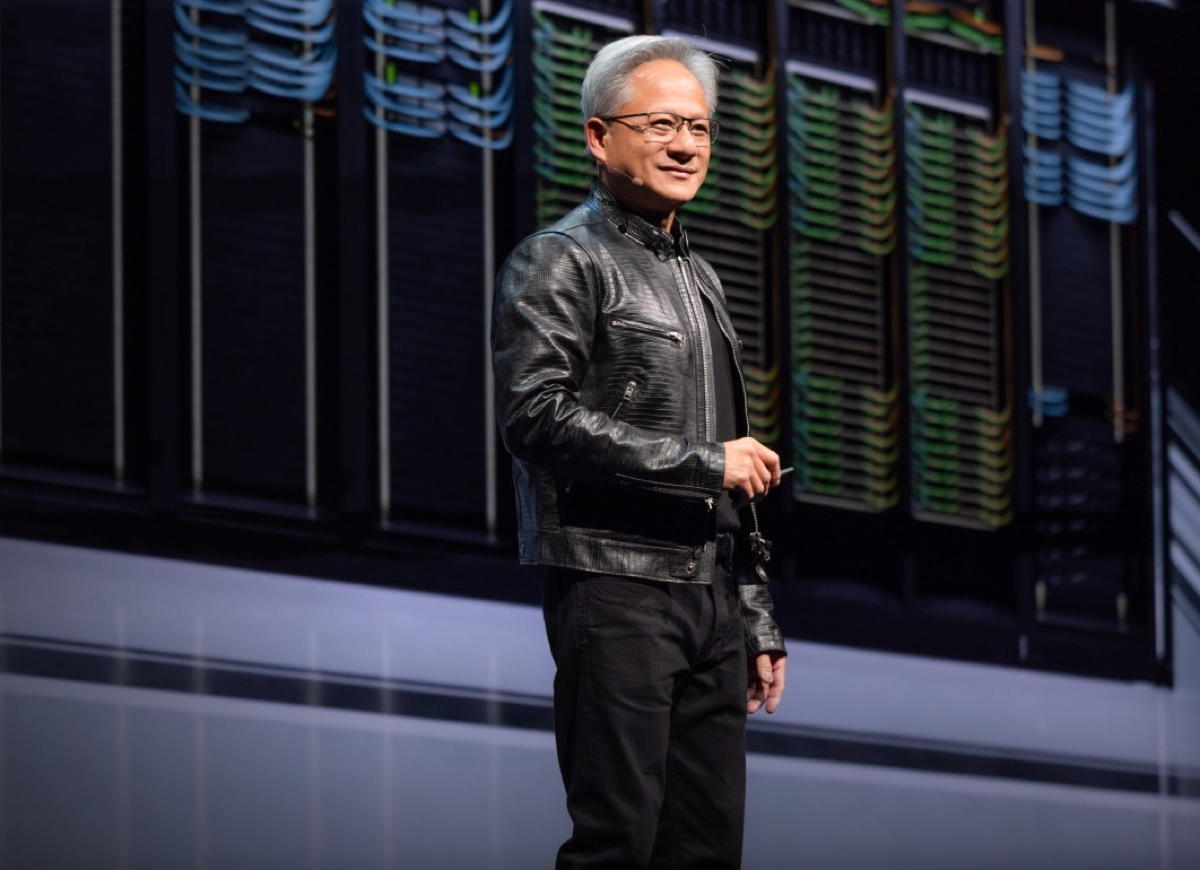
Nvidia chief executive Jensen Huang said the company will “probably” not invest $100 billion (£75bn) in OpenAI, following a much smaller $30bn investment as part of a funding round last week, giving the reason as the AI start-up’s likely IPO sometime this year. “I think the opportunity to invest $100 billion in OpenAI is probably not in the cards,” Huang said during a Morgan Stanley conference. Because of the expected IPO, “this might be the last time we’ll have the opportunity to invest in a consequential company like this,” Huang added.
Huang also indicated that Nvidia’s recent $10bn investment in Anthropic was probably “the last” in that company due to Anthropic’s expected IPO. The comments at the Morgan Stanley conference come after months of speculation around the relationship between Nvidia and OpenAI, two of the most prominent leaders in the generative AI boom that has swept the world. In September, Nvidia said it would invest up to $100bn into OpenAI over a period of several years, with the rounds of investment tied to the start-up’s successive deployments of Nvidia’s chips in data centres, but the companies provided few details.
Background of Nvidia and OpenAI Partnership
Nvidia has been a key supplier of graphics processing units (GPUs) that power OpenAI's large language models, including GPT-3 and GPT-4. The relationship between the two companies has been symbiotic: OpenAI's advances in AI drive demand for Nvidia's cutting-edge hardware, while Nvidia's chips enable OpenAI to train increasingly sophisticated models. However, the financial ties have been complex. In 2020, Nvidia invested in OpenAI's early funding rounds, but the scale of the potential $100bn investment announced in September raised eyebrows across the tech industry. The agreement was never finalized, and by January reports indicated the deal had stalled, partly due to disagreements over valuation and governance.
The Changing Economics of AI
The economics of the AI boom have shifted dramatically. Last year saw a wave of optimistic announcements about massive investments in AI infrastructure, but the reality of building and maintaining data centres is proving costly. Such facilities consume enormous amounts of power, water, and other natural resources. For example, training a single large language model like GPT-4 requires electricity equivalent to the annual consumption of several thousand households. Water is needed for cooling, and the carbon footprint of these data centres has drawn scrutiny from environmental groups and local communities. As a result, there is a growing backlash against the expansion of AI data centres, with residents in areas like Northern Virginia and Ireland protesting planned facilities.
Nvidia's reluctance to commit $100bn to OpenAI may also reflect a broader reassessment of risk. The generative AI market is becoming increasingly crowded, with competitors like Anthropic, Google, and Microsoft investing heavily. OpenAI itself faces challenges, including high operational costs and questions about its business model. The company is reportedly losing money on its ChatGPT subscription service despite its popularity. An IPO would provide OpenAI with access to public capital markets, allowing it to raise funds without diluting existing investors like Nvidia. However, it would also subject the company to greater regulatory scrutiny and quarterly earnings pressures.
Impact on the AI Industry
The news that Nvidia is stepping back from a massive investment in OpenAI could have ripple effects across the AI ecosystem. It signals that even the most dominant hardware provider sees limits to the current boom. Other tech giants may also reconsider their own investment strategies. For instance, Microsoft's multi-billion-dollar partnership with OpenAI, originally announced in 2023, has been structured around integrating OpenAI's models into Azure and Office products. If OpenAI goes public, Microsoft might have to adjust its own stakes.
Moreover, smaller AI startups may find it harder to attract funding from strategic investors like Nvidia. Huang's comments suggest that Nvidia is more cautious about pouring capital into companies that are approaching an exit via IPO. Instead, Nvidia may focus on providing hardware and software platforms, such as its CUDA ecosystem and DGX systems, rather than making direct equity investments.
Broader Market Dynamics
The AI hardware market itself is undergoing transformation. While Nvidia dominates the GPU market for AI, competitors like AMD and Intel are launching competitive chips. Additionally, cloud providers like Amazon AWS, Google Cloud, and Microsoft Azure are developing their own custom AI accelerators (AWS Trainium, Google TPU, and Microsoft Maia). This could reduce reliance on Nvidia over time, though Nvidia still holds a significant advantage in memory bandwidth and software ecosystem.
Investors have been closely watching Nvidia's moves. The company's stock price has soared over the past year, making it one of the most valuable companies in the world. However, any sign that the AI boom is slowing could lead to volatility. Huang's comments may be interpreted as a realistic assessment rather than pessimism. He emphasized that Nvidia will continue to partner with OpenAI and other AI companies, but with more caution.
OpenAI's potential IPO would be one of the most anticipated in tech history. The company is valued at around $80bn according to recent secondary market trades, though some analysts believe it could be worth substantially more if it goes public. The IPO would provide liquidity for early investors, including Nvidia, and allow the company to pursue its ambitious mission of achieving artificial general intelligence.
In the meantime, the AI industry must navigate challenges such as energy costs, regulatory hurdles, and ethical concerns. The resource intensity of large-scale AI models is prompting research into more efficient algorithms and hardware. For example, Nvidia is working on next-generation architectures like Blackwell and Grace Hopper that promise better performance per watt. Governments are also beginning to impose regulations on AI, including the European Union's AI Act, which could affect how companies train and deploy their models.
The relationship between hardware suppliers and AI developers will continue to evolve. Nvidia's decision not to invest $100bn in OpenAI does not indicate a rift; rather, it reflects a maturing market where investment decisions are based on strategic alignment rather than hype. As Huang put it, the opportunity to invest in a once-in-a-lifetime company like OpenAI is rare, but that doesn't mean every opportunity must be seized.
Overall, the AI sector remains dynamic, with shifts in investment patterns, technology cycles, and competitive landscapes. Huang's comments serve as a reminder that even the most bullish narratives must be tempered with business realities. The coming months will reveal whether other industry players follow Nvidia's lead or double down on their AI bets.
Source: Silicon UK News